 Houjun Lab
Small experiments,
measured honestly.
Houjun Lab is where we write up research run on a single Mac, with nothing sent to an outside service: answering questions from your own documents, teaching a model new material and measuring what it forgets, and reading receipts, speech, images and video locally. Each project fixes its tests before any result exists, keeps the results that did not work, and links to code you can run again.
The two things organisations ask for first
An AI that answers from your own documents, and an AI that has learned your own material. Both were measured here on one machine, with nothing sent outside.
Ask your own documents
Search by meaning across Chinese, Japanese and English, then answers from a local model that cite every source and say so when the documents do not contain the answer. About six seconds per answer, fully offline.
Read the project → CompletedTrainingLanguage modelsMedAdapt Lab
Can a small language model learn new findings by reading research papers? Five experiments on openly licensed 2026 ADHD papers and on fictional trials: what it learns, what it forgets, and why rewording beats repetition.
Read the project →More studies
Each asks the same three questions of one kind of model: can it ship, what does it cost, and how does it fail?
Reading receipts and images
16 of 17 fields on a real Japanese receipt, locally, in about 11 seconds, and why three identical answers can all be wrong.
Read the project → CompletedLanguage modelsA local language model
How big a model an office Mac can run, and at what settings: 30 tokens a second, 8K context, compressed working memory with no measured loss.
Read the project → CompletedSpeechSpeech to text, offline
Meeting audio to text at 7.6 times real time, silence that turns into "Thank you.", and live captions in three languages.
Read the project → CompletedSpeechVoice cloning, verified
A clone that sounded right and silently skipped 17% of the text, and the transcribe-back check that caught it.
Read the project → CompletedGenerationLocal video generation
From seven minutes to one per clip, a preview decoder 665 times faster, and the settings that quietly break video.
Read the project → CompletedGenerationLocal image generation
A 1024×1024 image in 55 seconds, perfectly repeatable, and still five lanterns when three were asked for.
Read the project → CompletedComputer visionCPU inferenceVision Lab
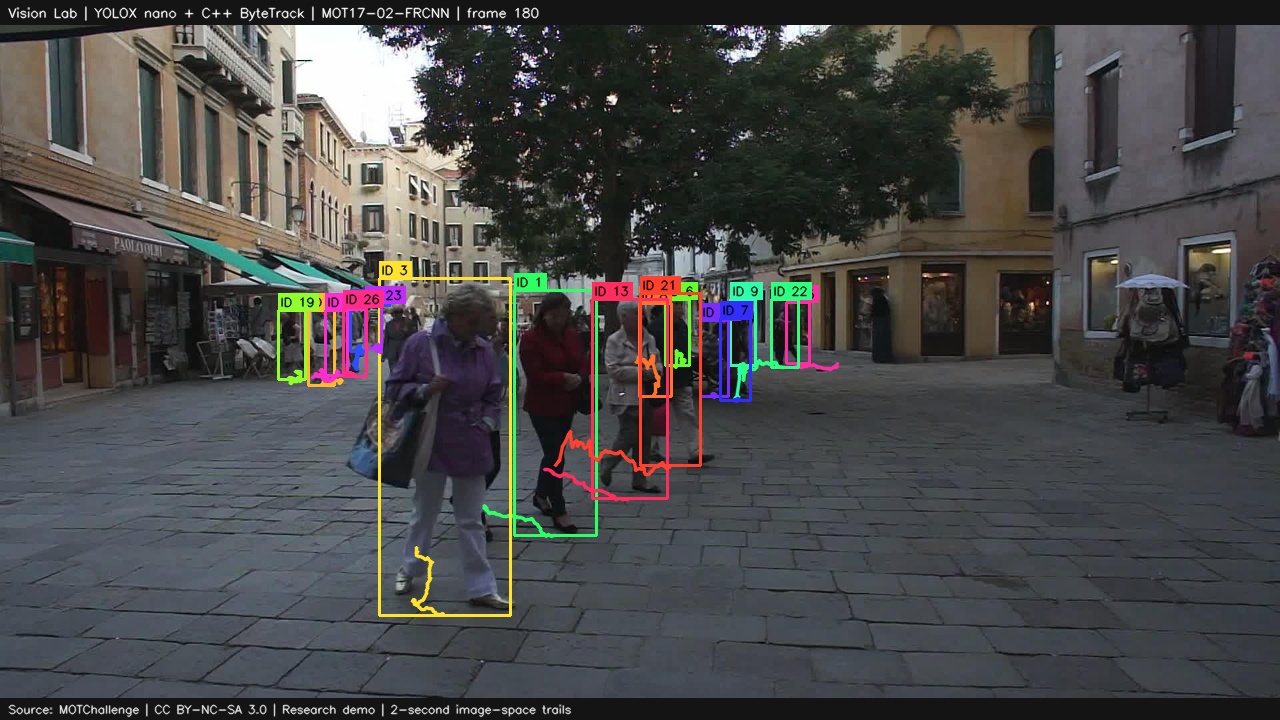
Pedestrian detection and tracking in C++ on a CPU: a port that matches its reference row for row, 27 frames per second on four threads, 56 MOTA on MOT20's denser crowds (69 on its training footage), and an 8-bit version that helped one model and broke the other.
Read the project →How we work
The rules every project here follows, so that a result means what it says.

Tests before results
Exams, evaluation data and pass/fail rules are written and frozen first. Their checksums are recorded, so a test cannot quietly change after the results are known.

A control for every claim
A gain only counts if a matched control does not show it too: material the model was trained on is always compared with material it was not.

Negative results stay
Runs that failed, effects that did not appear and measurement mistakes are reported next to the successes, with what we changed and why.

Reproducible on one machine
Pinned model revisions, hashed data and logged settings. Everything runs locally on an Apple Silicon Mac with open tools.

Licensed data only
We use only data whose licence allows it, check that licence item by item, and do not redistribute anyone else's data, papers or videos.

Research, not advice
These are experiments on how models behave. Nothing here is medical, legal or product advice, and no model from these projects is fit for real-world decisions.
Also from Houjun
Finished, open-source apps that run AI models locally on your Mac.